It took me a good 2-week time to reread this paper five times... including the last time when I took the notes down.
After 2 weeks, what I learned about this paper (and based on what I read in Dr. Baddeley's more recent publications... all the way into 2013) is that it was as he was at a point of trying to figure out whether the central executive should be considered the homunculus or whether it should be fractionated? It was as if he was at the point of wondering whether the functions of the central executive include components like the coordination and plan-switching of the WM slave systems, the attention controller, and the selection and manipulation of information in Long-Term memory (inhibition and "excitation"?).
In this paper, what he was doing was really "Exploring the central executive"--as stated in the title of the article... and, in the end, he frankly stated that he was not sure yet which way the future might lead... fractionation or not.
I don't know why my head wanted me to drill this paper this hard. Yet, interestingly, when reading his more recent paper including those targeting the model revision, it put things in a different perspective... the process of becoming of the theory itself.
I like it!
My two cents on Fractionating the CE
Thinking back to my psychotic experiment for my psychotic dissertation... where... I didn't realize till later than I was making people hear voices and see things. 8-X
Given the 99% principle, I am hardly sure about no nothing. Yet, I am almost 100% confident that the data collection and analysis adhered strictly to the protocol... including the processing of the random assignments of participants to the control and experiment groups (controlling for gender, ESL status)... not to mention the post-experiment interviews... all the way to the last data point collected... right before the Apocalypses kept on coming back like a broken record.
There is something strange about how it worked. How certain executive function could remain intact (relatively) when the mental status was at the institutionalizable grade. Sure, towards the hospitalization, I was hallucinating and being "all" delusional as the experiment was taking place... no different from any of my cohorts in the psychiatric ward.
The following notes are for myself. Might be too detailed for you... At the same time, how the notions etc in this paper are relevant to psychosis... might need to do it in another post since this one is already too long.
Baddeley, Alan. (1996). Exploring the Central Executive. The Quarterly Journal of Experimental Psychology Section A, 49(1), 5-28.
"I shall make extensive use of neuropsychological evidence, much of it from patients who have damage to the frontal lobes, but I do not propose to use anatomical localization as a defining criterion for the central executive."
Although this section is short, it provides us with Baddeley's view on the role of neuropsychological evidence in his theory.
Intelligence... What is intelligence? An interesting question people have been entertaining since its inception. Is one one single general capacity that could be captured by Spearman's g, or could it be broken down into subprocesses... and what might these subcomponents entail? Also, how do the performance on the subcomponents relate to each other?
Reminding me of Dweck... fixed entity or incremental in nature... intelligence. Since I am definitely getting old, with the synergistic effects of aging, my mental health conditions and the side effects of meds, I would like to subscribe to the fixed notion. At the same time, since I have lived many a time from 2, 3 words, incremental might serve my ego better. 8-O lol
Should CE be considered the homunculus or be fractionated? Starting from treating it as the homunculus before the evidence tells otherwise... and the path traversed so far...
The following provides more detailed description on the path traversed mentioned above.
Many a thing we know about stem from what's deviated from the norm. A good way to message my own already too much in the grandiosity end of ego.
First set of studies: Tracking task plus 1 distraction task: articulartory suppression, reaction time to a tone, digit span.
Results are consistent with the hypothesis that it might reflect AD patients' problems of CE in coordinating the slave systems of working memory.
Other interpretations:
a. The cost of the peripheral task rather than the issue in coordination
On the brain side: Executive task might be link with frontal-lobe function.
Disinhibited behaviours: "disturbed attention, increased distractibility, a difficulty in grasping the whole of the complicated state of affairs... while able to work along old routine lines... but cannot learn to master new types of task."
CE can activate long-term memory temporarily.
The story of KJ: KJ was an amnesic patient whose performance on the logical memory subset of Wechsler Memory Scale was above average although half an hour later, neither could he recall the stories and nor did he remember having been told these story. The question is... how did he get the above average performance?
The author speculated that, in order to comprehend, KJ would have to set up a mental model about the stories using components of LTM.
Whether the mind come into existence is a tabula rasa is not the topic of discussion here--though possibly not... Based on studies conducted on "non-newborns," it appears that the phonological loop is no tabula rasa and it is a system "developed on the basis of the phonological experiences of the remember."
Think about auditory hallucinations... where did they come from... they never sound like Greek to me (since I don't understand Greek).
According to the author, the view of STM represents active LTM components itself seems theoretically insufficient since it provides no insight into the processes involved. He is more interested in the differences between how these components behave in the phonological loop and visuospatial scatchpad, or the role of the slave systems in the encoding of memories of multimodality.
Research on the role of WM in the retrieval and encoding of LTM:
The plausible automaticity in knowledge retrieval: As in the FOK research, FOK might not be accurate. Yet, false positive is OK (all's symptom)... thus no need for verification as as to minimize the workload of WM. Considering that our WM might not be so sharp, though might not be doing anything constructive, no nothing detrimental at least... Do no harm.
This is why I have a liking about the notion of fuzzy algorithm... something I really have no inkling about. No need to be exact since the purpose is to survive... not to conduct scientifically based research.
Sure, there are individual differences in our capacity and we all have our own bottleneck. At least, we have our own bottleneck to push and our own best to strive to perform in the face of life.
After 2 weeks, what I learned about this paper (and based on what I read in Dr. Baddeley's more recent publications... all the way into 2013) is that it was as he was at a point of trying to figure out whether the central executive should be considered the homunculus or whether it should be fractionated? It was as if he was at the point of wondering whether the functions of the central executive include components like the coordination and plan-switching of the WM slave systems, the attention controller, and the selection and manipulation of information in Long-Term memory (inhibition and "excitation"?).
In this paper, what he was doing was really "Exploring the central executive"--as stated in the title of the article... and, in the end, he frankly stated that he was not sure yet which way the future might lead... fractionation or not.
I don't know why my head wanted me to drill this paper this hard. Yet, interestingly, when reading his more recent paper including those targeting the model revision, it put things in a different perspective... the process of becoming of the theory itself.
I like it!
My two cents on Fractionating the CE
Thinking back to my psychotic experiment for my psychotic dissertation... where... I didn't realize till later than I was making people hear voices and see things. 8-X
Given the 99% principle, I am hardly sure about no nothing. Yet, I am almost 100% confident that the data collection and analysis adhered strictly to the protocol... including the processing of the random assignments of participants to the control and experiment groups (controlling for gender, ESL status)... not to mention the post-experiment interviews... all the way to the last data point collected... right before the Apocalypses kept on coming back like a broken record.
There is something strange about how it worked. How certain executive function could remain intact (relatively) when the mental status was at the institutionalizable grade. Sure, towards the hospitalization, I was hallucinating and being "all" delusional as the experiment was taking place... no different from any of my cohorts in the psychiatric ward.
How can psychotics with manageable symptoms perform tasks and hold jobs? An interesting question.
Perhaps, because of the intact executive functions albeit the dysfunctions in the rest? Something to support the fractionation notion of the central executive, I guess.
The following notes are for myself. Might be too detailed for you... At the same time, how the notions etc in this paper are relevant to psychosis... might need to do it in another post since this one is already too long.
Baddeley, Alan. (1996). Exploring the Central Executive. The Quarterly Journal of Experimental Psychology Section A, 49(1), 5-28.
Strategies for analyzing the central executive
The executive as ragbag
In this section, Baddeley acknowledge the fact that their initial specification of the central executive (CE) was vague and CE is "little more than a ragbag" stuffed with things like strategy selection, planning, retrieval checking. In 1986, the theorists finally attempted to specify CE in greater details... relying heavily on the Supervisory Activating System (SAS) component of Norman and Shallice's (1980) model of attentional control.The central executive and the frontal lobes
Abundant evidence showed that disordered executive control are associated with damages to the frontal lobes (Shallice, 1982, 1988). While the author regarded highly of the neuropsychological evidence, he also cautioned that if the CE is identified exclusively with frontal function, there is a risk of excluding executive processes because they are not frontally located or considering functions as executive simply because they are based in frontal lobe."I shall make extensive use of neuropsychological evidence, much of it from patients who have damage to the frontal lobes, but I do not propose to use anatomical localization as a defining criterion for the central executive."
Although this section is short, it provides us with Baddeley's view on the role of neuropsychological evidence in his theory.
Psychometric approaches to the central executive
Two separate but related lines of research:- Traditional concept of intelligence
- Working memory involves the simultaneous storage and manipulation of material (Baddeley and Hitch, 1974)
Intelligence... What is intelligence? An interesting question people have been entertaining since its inception. Is one one single general capacity that could be captured by Spearman's g, or could it be broken down into subprocesses... and what might these subcomponents entail? Also, how do the performance on the subcomponents relate to each other?
Reminding me of Dweck... fixed entity or incremental in nature... intelligence. Since I am definitely getting old, with the synergistic effects of aging, my mental health conditions and the side effects of meds, I would like to subscribe to the fixed notion. At the same time, since I have lived many a time from 2, 3 words, incremental might serve my ego better. 8-O lol
The Homunculus: Friend or Foe?
What approach does Baddeley adopt? "...we adopt neither the anatomical nor the classic psychometric approach."Should CE be considered the homunculus or be fractionated? Starting from treating it as the homunculus before the evidence tells otherwise... and the path traversed so far...
- The coordination of the WM slave systems as the function of CE... research on patients with Alzheimer's disease.
- The link between CE to the SAS system by Norman and Shallice... research on random generation... plain switching
- CE could act as an attention controller
- CE's capacity in the selection and manipulation of information in Long-Term memory
The following provides more detailed description on the path traversed mentioned above.
Approaches to fractionating the executive
Following are the areas of research investigating Central Executive (CE).
Dual-task performance
The attempt to devise a measure on Central Executive (CE) stemmed from the intention to study Alzheimer's patient's deficit memory. It was hypothesized that this might reflect the problem of CE in coordinating the slave systems of working memory.Many a thing we know about stem from what's deviated from the norm. A good way to message my own already too much in the grandiosity end of ego.
First set of studies: Tracking task plus 1 distraction task: articulartory suppression, reaction time to a tone, digit span.
| Dual-task | AD patients vs. Elderly and young controls | |
| Visuospatial | pursuit tracking | |
| Phonological loop (Distraction task) | Articulatory suppression | No significant difference though significant impairment in AD patients reported elsewhere |
| Reaction time to tones | significant decrements in speed and accuracy than the control | |
| Digit span | Significantly decrease in tracking and memory performances in AD patients than the control |
Results are consistent with the hypothesis that it might reflect AD patients' problems of CE in coordinating the slave systems of working memory.
Other interpretations:
a. The cost of the peripheral task rather than the issue in coordination
- Difficulty levels adjusted for all group. There is no reason to assume the control groups are not devoting all their resources to perform the task.
- Deficit found in AD patients in this study and others are not found in normal aging. As some function of WM does appear to decline with age, it supports the notion of fractionating the CE.
- The results of dual-task performance did not support this notion given the performance of elderly control.
- It replaces problems associated with CE with those with intelligence.
- Varying task difficulties without increasing the demand for dual-task coordination
- Yntema and Mueser (1960) had shown that the time it takes to categorize a word would increase when there are more categories to select from.
- The category judgment task intended to assess the impact of the number of simultaneously presented categories on the time to decide whether a word belongs to a category. The participants were asked to decide whether the items they were provided belonged to the target categorie(s). If the answer is yes, they have to press the key responses on the screen (Guess this is the visiospatial part). There was a-six month interval between the tests during which the disease in the patients have progressed.
Following are factors showing significant results with key pressing the visiospatial task (I think) and categorization the Phonological task:
Based on these results, the authors concluded that, though the notion of difficulty level is a tricky one, the increase in task difficulty level will make the task more sensitive to the disease progress.
| Dual-task (modulating difficulty level through the number of categories) | ||||
| Var | Correct | misses | correct RT | |
| Time 1 | AD patients | Substantial drop between 1 to 2 and 1 to 4 categories | Substantial drop between 1 to 2 categories | Substantial drop between 1 to 2, 2 to 4, and 1 to 4 categories |
| Elderly control | ND | No sig difference | deteriorate with increasing numbers of categories. | |
| Group differences | yes | yes | yes | |
| Time 2 | AD patients | Results of two-way ANOVA with repeated measures found AD patients' performance to deteriate significantly over time and their performance to be poorer when the number of categories increase. However, no significant interaction effect. | Misses increase significantly with the number of category but not significant in test session or the interaction term. | Response time increase significantly with the number of category but not significant in test session or the interaction term. |
| Elderly control | Response time increase
significantly with the number of category but not significant in test session
or the interaction term.
|
|||
Based on these results, the authors concluded that, though the notion of difficulty level is a tricky one, the increase in task difficulty level will make the task more sensitive to the disease progress.
On the brain side: Executive task might be link with frontal-lobe function.
Disinhibited behaviours: "disturbed attention, increased distractibility, a difficulty in grasping the whole of the complicated state of affairs... while able to work along old routine lines... but cannot learn to master new types of task."
- Verbal fluency task is associated with left frontal lobe and the executive process of search and retrieval from long-term memory.
- Wisconsin Card Sorting Test... preservative errors are linked to frontal-lobe damages.
- Expert opinions on disinhibited behaviour
This was (hopefully was) so very me... an example... when I was trying to work on the marketing report before first institutionalization. Something I have to make sure... don't allow myself to progress back to this stage. Also, no truer words... the failure to select the focus of attention although different (kaputt) executive processes might differentially associated with overt behavior problems or symptomatology isn't etiology though they could be related. At the same time, albeit the differential physiological basis, there might be similarities in how the dysfunctions come about. Something interesting though... everything was dedicated to psychotic processing... though there was still some behavioral control since I didn't yell at all passersby crossing my path.
The author found Norman and Shallice's (1980) model to be of great help in explaining the aforementioned research. Norman and Shallice's model posited two sources of control of actions: the schemata (learned habits that might have reached automaticity) and the Supervisory Attentional System (SAS: an attentional system capable of overriding habitual behaviors and initiate new ones).
From this viewpoint:
Random generation of letters for instance involves:
Shiffrin and Schneider's (1977) notion of automaticity comes handy here with automaticity referring the state when stimulus will get response invoked... not need for the attentional demands.
From this viewpoint:
Random generation is the opposite of automaticity where the goal of the task is to minimize the association of what's to be generated with what got generated before.
Informed by these theoretical notions, the author wanted to know what random generation can tell us about the limited capacity executive system through a studying combining random generation through keypressing with performance on a memory span task (recalling sequences ranging from the length of 1 to 8 items). The study hypothesized that: "If performance depends upon a general purpose system, then there should be interference between the verbal memory task and the visuo-spatial generation task. Furthermore, if the system reflects a limited-capacity working memory, then the degree of disruption of random generation should increase with concurrent memory load."

Random generation competes for the same limited capacity as is necessary for performance of tasks depending more on the functioning of central executive.
The study was conducted using the computerized tracking task and found that patients with or without disinhibited behaviours do not different in their performance in verbal fluency or Wisconsin Card Sorting performance. However, those with behavior disorder demonstrated clear decrease in performance in the dual task condition where the box-crossing and digit span tasks were combined. The results was similar to that of Alderman where patients failing to benefit from the token economy system had more problems with the dual-task test than with standard "frontal" tests. Both pointed to the association between poor dual-task performance and behavioral problems.
Methodological and assessment issues: Inconsistencies in existing dual-task research led to the question of how to combine tasks and calculate the performance score.
The concluding words of the author about lessons learned from the dual task research is that "the capacity to carry out two tasks simultaneously appears to be a candidate for one separable feature of executive function" although more research needed.
As for the quote on "the capacity to carry out..."... There are times when things are within our control, in this kind of condition, if multitasking is impossible, let go of it as the trade-off of functionality... till... maybe... one day, you can work with music in the background.
Coordination: I definitely have problems coordinating multiple tasks, starting from coordinating between my psychotic and non-psychotic kinda thing. Worst off, after the accident, my already not so well-endowed department sensory motor coordination became even more kaputt with the even the body doesn't quite pay me no mind either. 8-O lol
Multitask: Multitasking is especially difficult when the condition is bad.. More exactly, only one default task is set to be performed--psychotic processing.
As for the quote on "the capacity to carry out..."... There are times when things are within our control, in this kind of condition, if multitasking is impossible, let go of it as the trade-off of functionality... till... maybe... one day, you can work with music in the background.
Coordination: I definitely have problems coordinating multiple tasks, starting from coordinating between my psychotic and non-psychotic kinda thing. Worst off, after the accident, my already not so well-endowed department sensory motor coordination became even more kaputt with the even the body doesn't quite pay me no mind either. 8-O lol
Multitask: Multitasking is especially difficult when the condition is bad.. More exactly, only one default task is set to be performed--psychotic processing.
Random generation
Encoding is hard. Alright... never promise you a rose garden. Yet, the good news is... if you are careful about what you encode.... retrieval seems to be a process close to automatic--the limited role of the attentional process in retrieval. Interesting notion I came across here---random generation as a manifestation of knowledge retrieval.
Results of studies on random generation of letters and studies where random generation was combined with a card-sorting task were consistent with the notion that the process of random generation was dependent on a system with limited capacity-- the faster the rate, the less random the output, and the larger the pool of selection, the slower the generation rate.
Results of studies on random generation of letters and studies where random generation was combined with a card-sorting task were consistent with the notion that the process of random generation was dependent on a system with limited capacity-- the faster the rate, the less random the output, and the larger the pool of selection, the slower the generation rate.
The author found Norman and Shallice's (1980) model to be of great help in explaining the aforementioned research. Norman and Shallice's model posited two sources of control of actions: the schemata (learned habits that might have reached automaticity) and the Supervisory Attentional System (SAS: an attentional system capable of overriding habitual behaviors and initiate new ones).
From this viewpoint:
Random generation of letters for instance involves:
- Schemata: Generation is the manifestation of the habitual letter-retrieval schemata at work
- SAS: SAS makes the generation random by constantly breaking up the stereotyped sequence in the schemata.
- SAS: SAS is also required when sorting cards into different categories
Shiffrin and Schneider's (1977) notion of automaticity comes handy here with automaticity referring the state when stimulus will get response invoked... not need for the attentional demands.
From this viewpoint:
Random generation is the opposite of automaticity where the goal of the task is to minimize the association of what's to be generated with what got generated before.
Informed by these theoretical notions, the author wanted to know what random generation can tell us about the limited capacity executive system through a studying combining random generation through keypressing with performance on a memory span task (recalling sequences ranging from the length of 1 to 8 items). The study hypothesized that: "If performance depends upon a general purpose system, then there should be interference between the verbal memory task and the visuo-spatial generation task. Furthermore, if the system reflects a limited-capacity working memory, then the degree of disruption of random generation should increase with concurrent memory load."

- Articulatory suppression (counting 1 to 6) had no significant effect on random generation.
- Category generation significantly disrupted the performance on random generation
- Verbal fluency seems to depend heavily on executive resources (susceptibility to concurrent digit span)
- impairments of patients with dysexecutive syndrome
- Patients' impairment to perform AH3, a test of fluid intelligence, which can be considered as an index of executive function and depending on the functionality of frontal lobes (Duncan, 1993).
Yet, in the dual-task condition where keypressing and number generation is combined, participants seemed to have performed well with concurrent digit generation, category generation, and holding a sequence of digits of span length had similar impact on the randomness of keypressing. Yet, asymmetrical interferences observed because concurrent keypressing was found to have less impact on digit generation.
Physical ability developed before numerical?
A model similar to Roediger's (1993) simpler retrieval version of SAM model (Raijmakers and Shiffrin, 1981) was proposed to explain the processes underlying random generation. The model involves setting up a retrieval plan, running it, checking for suitable randomness, and generate output at the appropriate time if passing the randomness check.
Physical ability developed before numerical?
A model similar to Roediger's (1993) simpler retrieval version of SAM model (Raijmakers and Shiffrin, 1981) was proposed to explain the processes underlying random generation. The model involves setting up a retrieval plan, running it, checking for suitable randomness, and generate output at the appropriate time if passing the randomness check.
- Time-limit imposes issues in the switching of retrieval plans.
- No time limit: Subjects should be able to switch plans all the time and there's no need to check randomness.
- Repeated use of the same plan will result in stereotyped and non-random responses.
- Interference with plan switching will increase redundancy
What the plan switching notion would, thus, predict a general reduction in randomness rather than catastrophic breakdown when the plans can be operate simultaneously (e.g., keypressing and digit generation).
Testing the switching hypothesis
Trails test from the Halstead-Reitan battery: joining numbered squared (Trails A) and alternating between lettered and numbered squared when connecting the squared A-1-B-2-C-3 (Trails B). Patients with frontal-lobe damages seems to have problems with the alternating task.
Since you can't make people do the keypressing task and do the Trails test at the same time, the verbal equivalent of the Trails test was used in the study.
Study 1
Keypressing alone or with a concurrent task
Study 2
Verbal equIvalence of Trails B starting from F-9 (F-9-G-10-H-11-I-12...) caused disruption in keypressing performance and the task itself was disrupted as well.
The authors concluded from results of these studies that the random generation's demand to constantly switching retrieval plans might be what disrupt the operation of CE... though more research needed.
Issues to be addressed... how does random generation assert its influence?
Automaticity? Drill, drill, and drill.
Testing the switching hypothesis
Trails test from the Halstead-Reitan battery: joining numbered squared (Trails A) and alternating between lettered and numbered squared when connecting the squared A-1-B-2-C-3 (Trails B). Patients with frontal-lobe damages seems to have problems with the alternating task.
Since you can't make people do the keypressing task and do the Trails test at the same time, the verbal equivalent of the Trails test was used in the study.
Study 1
Keypressing alone or with a concurrent task
- Reciting alphabets: no
- Counting digits: no
- Verbal equivalence of Trails B "A-1-B-2-C-3": detectable effect on the randomness of keypressing
Study 2
Verbal equIvalence of Trails B starting from F-9 (F-9-G-10-H-11-I-12...) caused disruption in keypressing performance and the task itself was disrupted as well.
The authors concluded from results of these studies that the random generation's demand to constantly switching retrieval plans might be what disrupt the operation of CE... though more research needed.
Issues to be addressed... how does random generation assert its influence?
- the need to switch plans?
- the problem to access plans?
- the monitoring of outputs?
Moi, get done with the need to switch... manually insert the new default to acounteract the biological defects.
Baddeley et all (1984): a degree of automaticity in the retrieval process.
Baddeley et all (1984): a degree of automaticity in the retrieval process.
Automaticity? Drill, drill, and drill.
Craik (1995): RT task and word retrieval.... RT was not affected by whether subjects were instructed to focus principally on retrieval or RT. Based on the study results, Craik suggests that learning depends on the available attention, retrieval depends on the operation of the retrieval mode. Also, encoding is more associated with the left frontal lobe while retrieval, right frontal lobe.
You just be damn sure that you get the right stuffs encoded.
You just be damn sure that you get the right stuffs encoded.
Selective Attention
Selective attention--one more plausible component of CE... the ability to attend to something while discarding the others.
Unfortunately, results of existing research on the impact of aging are inconsistent and make it difficult to come up with a cogent hypothesis about how it really works.
The problem of conducting theoretically driven studies on aging is that almost everything eventually decline with age somewhat. When the elderly performed poorly on a task, it's difficult to know exactly underlines the observed performance unless all possible factors can be ruled out.
Research on aging deficit using single measure
After partialing out the effects of general intelligence and speed of process, try to figure out whether there are additional factors impacting the participants' performance. If so, it would be a evidence to support the fractionation of CE.
Research paradigm:
Pressing key as fast as possible when the target stimuli occurred. (The additional task of counting the number of stimuli didn't change the pattern of the result.)
Manipulation of attentional demands: 1. irrelevant stimuli the participants had to ignore (Exp. 1 in other modality while Exp. 2 and 3, also in the same modality). 2. Instructions requiring them to switch from responding signals in one modality to those in the other.
Since it is not a published article, I tried my best to restructured the results in my own way here... shall you be able to comprehend.
I don't know why it was not published (unless published under a different title) but I think there are some interesting experiments.
In the first two experiments, results consistently showed that irrelevant stimuli in the unattended modality slowed down the RT with the elderly slower than the younger. However, controlling for the effect of "fluid intelligence," the age effect disappeared.
The condition in which the participants were asked to switch their attention to stimuli in the other modality was taken out from the third experiment because slower RT, especially the first response after switching, were observed and the age effect disappeared after partialling out the fluid intelligence factor in the first two sets of the experiments. The authors suspected that it might be the manifestation of negative priming.
Negative priming... still related to worldview--> the inability to wsitch since you have been thinking this way since you became psychotic.
In the third set of the experiment, the authors added the scenario of irrelevant stimuli in the same modality (i.g., visual, auditory). Controlling for the effects of "fluid intelligence" and "processing speed" (defined by the mean reaction time to ignore irrelevant stimuli in the unattended modality), there was still age effect on the time it takes to respond to target stimuli while having to ignore the irrelevant stimuli in the same modality.
The author stated that the findings were in line with Hasher and Zacks' (1988) proposal that "age limits the capacity for utilizing inhibition to sharpen attentional focus and limit distraction." Since age effect disappeared when the distractors were in a different modality, it means there is no general deficit. Thus, CE might have multiple components.
Low latent inhibition? We age faster? 8-O
The author also speculated what the differential inhibition abilities between the young and the elderly might be.
Ain't got no doubt that I have reduced ability in the inhibition department. Also "subjects were slower in responding when they had to ignore irrelevant stimuli, particularly when these occurred within the same sensory dimension." No doubt... no wonder the work would suffer... take the phonological loop for instance... gotta maintain auditory hallucinations and verbal information together... overworked la!
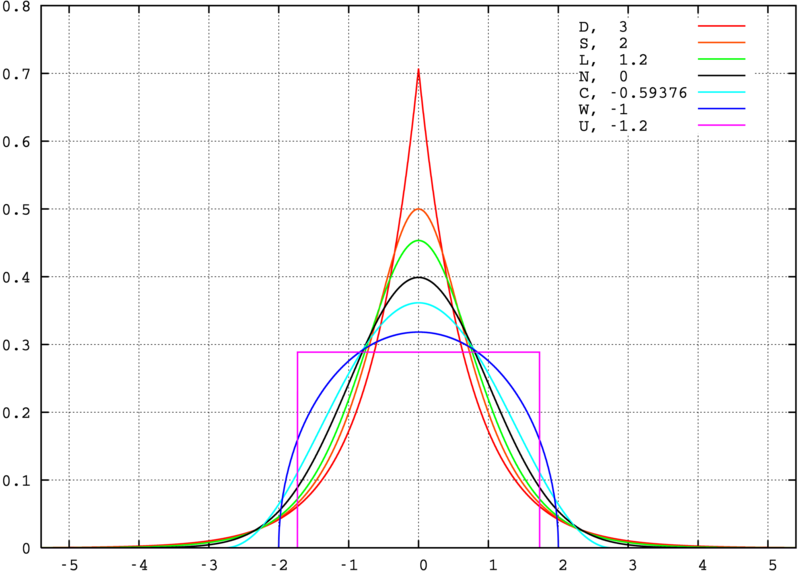
For me, it sounds almost like... if the attentional focus is represented by a bell-shaped distribution with the target at the center, it's almost like the distributions (attentional focus) between the young and the elderly differ in the kurtosis perspective of the distribution (and of course... shall the mean and skewness of the distribution be set to zero).

Unfortunately, results of existing research on the impact of aging are inconsistent and make it difficult to come up with a cogent hypothesis about how it really works.
The problem of conducting theoretically driven studies on aging is that almost everything eventually decline with age somewhat. When the elderly performed poorly on a task, it's difficult to know exactly underlines the observed performance unless all possible factors can be ruled out.
Research on aging deficit using single measure
- General intelligence (Rabbitt, 1983)
- Speed of processing (Salthouse, 1991)
- Reduced capacity for inhibition (Hasher & Zacks, 1988)
After partialing out the effects of general intelligence and speed of process, try to figure out whether there are additional factors impacting the participants' performance. If so, it would be a evidence to support the fractionation of CE.
Research paradigm:
Pressing key as fast as possible when the target stimuli occurred. (The additional task of counting the number of stimuli didn't change the pattern of the result.)
Manipulation of attentional demands: 1. irrelevant stimuli the participants had to ignore (Exp. 1 in other modality while Exp. 2 and 3, also in the same modality). 2. Instructions requiring them to switch from responding signals in one modality to those in the other.
Since it is not a published article, I tried my best to restructured the results in my own way here... shall you be able to comprehend.
I don't know why it was not published (unless published under a different title) but I think there are some interesting experiments.
In the first two experiments, results consistently showed that irrelevant stimuli in the unattended modality slowed down the RT with the elderly slower than the younger. However, controlling for the effect of "fluid intelligence," the age effect disappeared.
The condition in which the participants were asked to switch their attention to stimuli in the other modality was taken out from the third experiment because slower RT, especially the first response after switching, were observed and the age effect disappeared after partialling out the fluid intelligence factor in the first two sets of the experiments. The authors suspected that it might be the manifestation of negative priming.
Negative priming... still related to worldview--> the inability to wsitch since you have been thinking this way since you became psychotic.
In the third set of the experiment, the authors added the scenario of irrelevant stimuli in the same modality (i.g., visual, auditory). Controlling for the effects of "fluid intelligence" and "processing speed" (defined by the mean reaction time to ignore irrelevant stimuli in the unattended modality), there was still age effect on the time it takes to respond to target stimuli while having to ignore the irrelevant stimuli in the same modality.
The author stated that the findings were in line with Hasher and Zacks' (1988) proposal that "age limits the capacity for utilizing inhibition to sharpen attentional focus and limit distraction." Since age effect disappeared when the distractors were in a different modality, it means there is no general deficit. Thus, CE might have multiple components.
Low latent inhibition? We age faster? 8-O
The author also speculated what the differential inhibition abilities between the young and the elderly might be.
Ain't got no doubt that I have reduced ability in the inhibition department. Also "subjects were slower in responding when they had to ignore irrelevant stimuli, particularly when these occurred within the same sensory dimension." No doubt... no wonder the work would suffer... take the phonological loop for instance... gotta maintain auditory hallucinations and verbal information together... overworked la!
For me, it sounds almost like... if the attentional focus is represented by a bell-shaped distribution with the target at the center, it's almost like the distributions (attentional focus) between the young and the elderly differ in the kurtosis perspective of the distribution (and of course... shall the mean and skewness of the distribution be set to zero).
Activation of long-term memory
A major portion of what I have run my mouth on is about the encoding and retrieval of LTM. Nelson and Narens and Flavell all had spoken of LTM... Didn't really grasp the importance of LTM until Chi.CE can activate long-term memory temporarily.
The story of KJ: KJ was an amnesic patient whose performance on the logical memory subset of Wechsler Memory Scale was above average although half an hour later, neither could he recall the stories and nor did he remember having been told these story. The question is... how did he get the above average performance?
The author speculated that, in order to comprehend, KJ would have to set up a mental model about the stories using components of LTM.
Whether the mind come into existence is a tabula rasa is not the topic of discussion here--though possibly not... Based on studies conducted on "non-newborns," it appears that the phonological loop is no tabula rasa and it is a system "developed on the basis of the phonological experiences of the remember."
Think about auditory hallucinations... where did they come from... they never sound like Greek to me (since I don't understand Greek).
According to the author, the view of STM represents active LTM components itself seems theoretically insufficient since it provides no insight into the processes involved. He is more interested in the differences between how these components behave in the phonological loop and visuospatial scatchpad, or the role of the slave systems in the encoding of memories of multimodality.
Research on the role of WM in the retrieval and encoding of LTM:
1. Recency effect (Baddeley& Hitch, 1993)
2. Working memory span (Daneman & Carpenter, 1980): The simultaneous need for the participants to process and store information by presenting them with a series of sentences and ask them to recall the last word of each sentence. The maximum number of sentences to be processed while retaining the final word is the working memory span, which typically range between 2-5.
2. Working memory span (Daneman & Carpenter, 1980): The simultaneous need for the participants to process and store information by presenting them with a series of sentences and ask them to recall the last word of each sentence. The maximum number of sentences to be processed while retaining the final word is the working memory span, which typically range between 2-5.
- Turner and Engle (1989) replaced arithmetic operation with the sentence verification component of Daneman-Carpenter task. This provided evidence for a more general limited-capacity system as opposed to a language processing system. Score correlated highly with intelligence but exactly what it means... the author seemed to be unsure.
- Cantor and Engle (1993) adapted the fan effect (Anderson, 1974) assumptions and techniques. Anderson (1974) found out that it took participants less time to verify an object with fewer attributes/propositions than those with more. He explained the pattern by stating that each unit of the sentence triggers a limited amount of activation that spread to the associated features. Since the amount of the activation is limited, the link to the associated features would be weaker when there are more features/propositions. Cantor and Engle found that "the slope relating set size to verification time is steeper for subjects with a low working memory span (i.e., Daneman & Carpenter, 1980)" than for those with a high working memory span-- high-working-memory span subjects might have more activation available.
"working memory might reflect the temporary activation of areas of long-term memory, with high-span subjects being able to activate more extensive regions of long-term memory." Low latent inhibition... we psychotics? 8-O lol
Fan effect: like the example used in the analogy study on how to treat cancer patients... be targeted, identify the attributes of the symptoms--the themes-- rather than incidence by incidence. Without the language, patients and people in general actually already do it automatically. Since patients with thought disorder are already thinking too much (preferable or not), we should be able to learn to think thematically--a way to help unrest our brains to learn to think.
- Working memory span, fan effect, and Sternberg's "internal memory scanning mechanism" (the time it takes to decide whether a probe cames from a set is dependent on the set size.)
- Conway and Engle (1994) conducted a study linking the fan effect and Sternberg's finding. Participants were taught 2, 4, 6, and 8 letters to the extent that they can recall them perfectly and they can identify whether a letter belong to a given group. The reaction time increased with the increase in set size and the slope between the set size and reaction time was steeper for than low-working-memory span group than the high group. In addition, by delaying the presence of the probe after showing the set to be considered, Conway and Engle found that working memory span has no influence on the time to retrieve the info but the time it takes to perform verification. It was thus concluded that the task of memory retrieval is automatic (imposing no stress on the limited-capacity system) though the time it takes to verify is dependent on the capacity of the system. (My question... is the retrieval from the STS or from the LTM?)
Love this part... "the data described so far are captured well by a model that assumes that individual differences in working memory reflect differences between subjects in the amount of activation available. However, despite of this supportive evidence, Engle reports two further observations that cause him to abandon this hypothesis." (Holly cow! I really admire these researchers... like... not kosher... dumb it out?!)
First, what affects the high-working-memory group fail to have impact on the low-working-memory group
- Dual task condition with category-generation task and something else
- Having subjects to learn a subset of items to not include in category generation... even when the category they learned to exclude was totally different from the category they had to generate from. Second, even more for the excitation hypothesis... how Sternberg's paradigm was applied... in Conway and Engle (1994). Engle was concern that there were redundancies in the letters he used in the four sets in Conway and Engle (1994) and decided to run new experiments ridding off the redundancy issue. In the results of these new experiments, the group difference in the slopes disappeared. As a result, Engle entertained the notion of an executive with limited capacity to inhibit irrelevant information.
The concluding words of Baddeley for this section: "The presence of individual differences in inhibitory capacity does not, of course, rule out the possibility that excitatory processes also differ across individual. However, Engle's results suggest at the very least that we need to look very carefully at claims for such differences."
The plausible automaticity in knowledge retrieval: As in the FOK research, FOK might not be accurate. Yet, false positive is OK (all's symptom)... thus no need for verification as as to minimize the workload of WM. Considering that our WM might not be so sharp, though might not be doing anything constructive, no nothing detrimental at least... Do no harm.
This is why I have a liking about the notion of fuzzy algorithm... something I really have no inkling about. No need to be exact since the purpose is to survive... not to conduct scientifically based research.
Sure, there are individual differences in our capacity and we all have our own bottleneck. At least, we have our own bottleneck to push and our own best to strive to perform in the face of life.
Conclusion: Should we sack the Homunculus?
More work needed... the future is yet to be seen.
The notion of low and high capacity kept on surfacing in this line of research. The way I see it, having the realization of how the capacity can be constrained as a result of the medication and symptoms, let me accept the reality that I belong to the low capacity group. As a result, I have to make extra effort on the things I attend to because what I attend to is likely to be encoded in my hard drive and be retrieved in the future. The notion of phonological loop as no tabula rasa, for instance, also supports my way of thinking... that is... the operation of CE is partially dependent on what you have in LTM... remember the classic notion in data analysis... garbage in, garbage out... be ware what you put into the analysis engine. Grand delusional systems did not get built in one day... It's built through the constant recycling of disordered thoughts encoded in LTM.
The notion of low and high capacity kept on surfacing in this line of research. The way I see it, having the realization of how the capacity can be constrained as a result of the medication and symptoms, let me accept the reality that I belong to the low capacity group. As a result, I have to make extra effort on the things I attend to because what I attend to is likely to be encoded in my hard drive and be retrieved in the future. The notion of phonological loop as no tabula rasa, for instance, also supports my way of thinking... that is... the operation of CE is partially dependent on what you have in LTM... remember the classic notion in data analysis... garbage in, garbage out... be ware what you put into the analysis engine. Grand delusional systems did not get built in one day... It's built through the constant recycling of disordered thoughts encoded in LTM.


